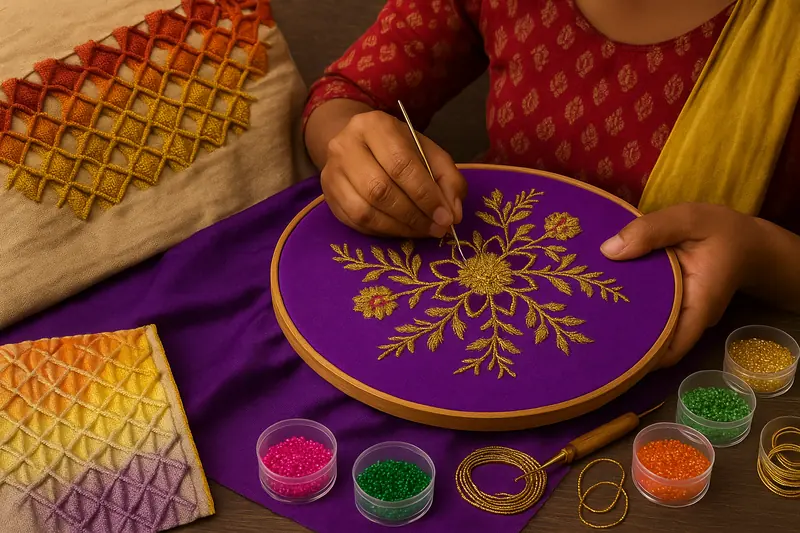
Walk into any bridal boutique and you will hear three words again and again: aari, zardozi and hand embroidery. They can look alike from a distance, but they use different tools, materials and techniques. Here is a plain-language guide to telling them apart – and deciding which to learn.
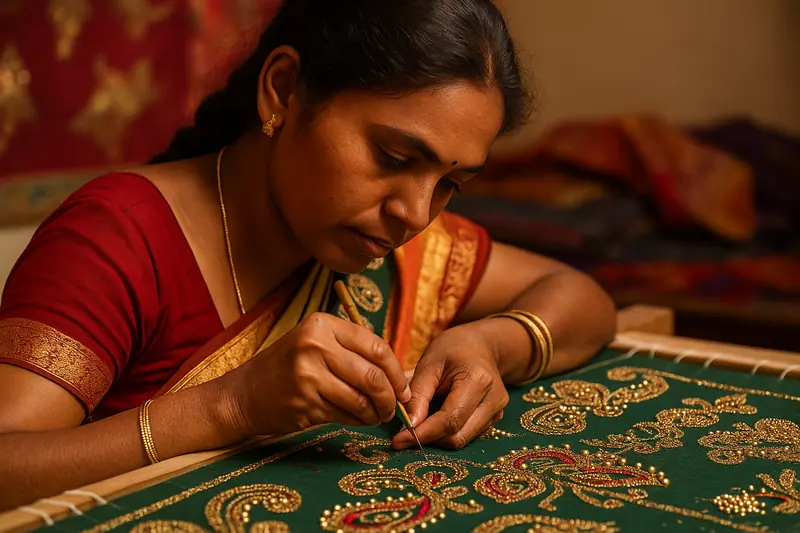
The differences at a glance
| Hand embroidery | Aari work | Zardozi | |
|---|---|---|---|
| Main tool | Ordinary needle and thread, often in a hoop | Hooked aari needle on a stretched frame | Needle on a frame, with metallic thread and wire |
| Typical look | Flat or lightly raised stitches such as satin stitch, chain stitch and French knots | Fast, even chain stitches, often with beads, sequins and stones | Heavy, raised, metallic designs with beads, pearls and stones |
| Common uses | Kurtas, dupattas, cushion covers, children’s wear | Blouses, lehengas and bridal wear | Bridal and ceremonial wear, borders and heavy festive garments |
Hand embroidery
Hand embroidery is the broadest category: decorative stitching done by hand with a needle and thread. It starts with simple stitches – running stitch, backstitch, satin stitch, chain stitch and the French knot – and extends to techniques such as mirror work and bead and sequin attachment. Because the tools are simple, it is the best place to begin. Our Hand Embroidery with Fabric Smocking course covers these foundations.
Aari work
Aari work, also written Ari and often called maggam work in South India, uses a fine hooked needle with the fabric stretched tight on a frame. The hook forms quick, continuous chain stitches, which makes it much faster than stitching with a straight needle and ideal for the dense embellishment seen on bridal blouses and lehengas. Beads, sequins and stones are added on top for texture and sparkle. See our Aari Work course (Basic and Advanced).
Zardozi
The word zardozi comes from the Persian zar (gold) and dozi (embroidery). Traditionally worked with gold and silver thread and wire, it builds raised, richly textured designs, today often using metallic-coated thread along with beads, pearls and stones. Zardozi is associated with royal and bridal garments and is introduced in our Hand Embroidery course.
Can they be combined?
Yes, and on bridal garments they often are. A blouse might use aari chain stitch for outlines and fills, zardozi for raised metallic motifs, and hand-stitched beadwork for finishing touches. Understanding all three lets you design – and price – embellished garments with confidence.
Which should you learn first?
- Complete beginner: start with hand embroidery to build control of the needle, thread and fabric.
- Want to embellish blouses and take bridal orders: add aari work for speed and density.
- Want a career in couture and bridal design: take both, plus bridal wear designing and tailoring so you can design and stitch the whole garment. The 2-year diploma covers all of them.
What to look for in an embroidery class
- A small batch, so the instructor can check your tension and stitch quality
- Frames, hoops and kits provided or clearly listed
- Practice samplers before you move to a real garment
- A finished portfolio piece, such as a blouse panel or a border
Ready to start learning in Virar West?
Talk to us about the right course, fees and the next batch.